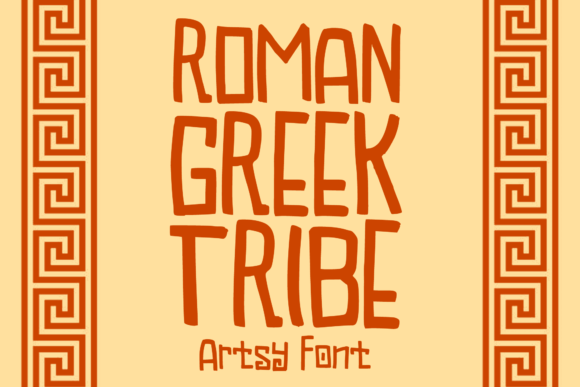
Roman Greek Tribe Font for Artsy Display Projects
It was 10:47 a.m., coffee half gone, and I’d just opened a fresh brand board for a local handmade ceramics studio — earthy glazes, hand-thrown forms, quiet elegance. Their request? “Something ancient but alive. Not dusty museum text — more like a whispered myth carved into clay.” That’s when I dropped Roman Greek Tribe onto the logo draft. Instantly, the mood shifted. Not because it’s “vintage” in a cliché way, but because Roman Greek Tribe carries real texture: chisel-cut serifs, subtle asymmetry, uneven stroke contrast, and that unmistakable warmth of ink pressed into papyrus or engraved into marble. It’s not a historical replica — it’s an artsy display font with an old Roman Greek era theme, designed to feel handmade, human, and quietly authoritative.
Roman Greek Tribe for Greeting Cards and Handmade Shop Branding
I tested Roman Greek Tribe on a set of seasonal greeting cards — think olive branch motifs, linen paper stock, blind debossing. At 24–36pt, the font shines: each letter has presence without shouting, and the slight irregularity adds charm, not confusion. As a display font, it works best for short bursts — “With Love,” “Season’s Greetings,” “Handmade in Athens, OH” — not paragraphs. On thick cardstock, the serifs hold beautifully; on thinner digital mockups, it still reads cleanly at headline sizes. For handmade shop branding (think Etsy shops, craft fairs, or small-batch product labels), Roman Greek Tribe signals intentionality and craft — it tells customers this isn’t mass-produced. Just remember: it’s a display font, not a workhorse. Pair it with a clean, neutral sans serif (like Montserrat Light or Lato Regular) for body copy, and you’ve got rhythm, contrast, and clarity.
Roman Greek Tribe for Kids’ Book Designs and Stickers
Yes — really. When I mocked up a spread for a myth-inspired early reader (think “Persephone’s Garden” with watercolor illustrations), Roman Greek Tribe became the title treatment on every chapter opener. Its friendly weight and open counters kept it legible for young eyes, while the classical flair gave instant thematic grounding. For stickers — especially die-cut shapes like laurel wreaths or amphorae — Roman Greek Tribe adds instant character without feeling stiff or academic. It’s playful enough for kids’ book designs, yet refined enough for boutique sticker sheets sold at indie bookshops or museum gift stores. As a fonts choice, it bridges whimsy and heritage — no easy feat. Just avoid tight tracking or all-caps settings below 18pt; the details soften at smaller sizes.
Roman Greek Tribe for T-Shirts and Poster Design
This is where Roman Greek Tribe truly flexes. On a distressed cotton tee mockup, centered in charcoal gray, the font held its own — bold, tactile, and full of implied history. Same with a 24"x36" event poster for a neighborhood storytelling night: large-scale, single-line phrases (“The Gods Are Listening”) popped with gravitas and warmth. As a display font, it thrives in high-impact, low-word-count contexts. The serifs catch light differently on fabric or matte paper, adding subtle dimension. But be realistic: it’s not built for long slogans or stacked multi-line layouts. If your t-shirt design needs three lines of text, use Roman Greek Tribe for the top line only — then switch to a sturdy sans serif underneath. And always test print. What looks elegant on screen can blur slightly in embroidery or screen-print halftones.
Roman Greek Tribe for Wedding Invitations and Elegant Branding
I used Roman Greek Tribe on a wedding stationery suite for a couple hosting their ceremony at a restored Greco-Roman garden pavilion. No clichés — no laurel borders or faux-marble textures. Just crisp ivory paper, blind embossing, and Roman Greek Tribe for names and date. The result? Timeless, unhurried, and deeply personal. Its artsy display font personality avoids the sterility of modern calligraphy fonts and the stiffness of traditional serif fonts. It feels ceremonial without being formal — perfect for couples who want elegance rooted in story, not status. As with all display fonts, keep it reserved for key moments: names, dates, monograms. For RSVP cards or directions, lean on a classic serif (like Playfair Display) or a soft sans (like Nunito). And always verify licensing: Roman Greek Tribe is a commercial font, so double-check usage rights before applying it to client wedding templates, printable invites, or digital suites sold on Creative Market.
Quick Practical Notes Before You Use Roman Greek Tribe
- Roman Greek Tribe is a display font — best for headlines, logos, posters, and short decorative phrases, not body text or UI interfaces.
- It performs strongest at 18pt and above on screen, and 12pt+ on high-res print — avoid using it below 10pt anywhere.
- Check file formats: most versions include OTF and TTF; webfont support varies — confirm WOFF/WOFF2 availability if using on websites.
- No ligatures or stylistic alternates are mentioned in the source description, so don’t expect swashes or discretionary glyphs — its charm is in its intentional simplicity.
- Always review the commercial license: using Roman Greek Tribe on merchandise (t-shirts, mugs, stickers), client brand identities, or digital templates requires proper licensing — never assume “personal use only” covers your project.